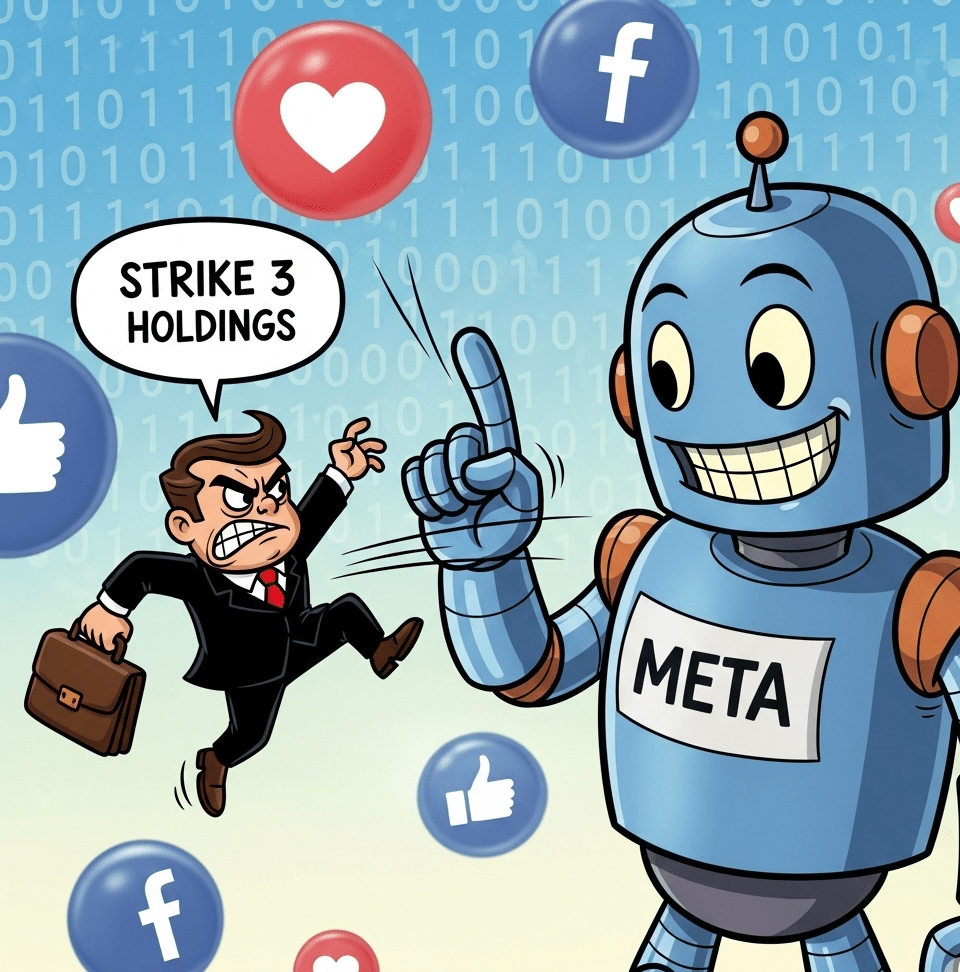
Will Federal Courts Let Strike 3 Holdings Use Its “Settlement Business Model” Against Meta?
Over the last decade, Strike 3 Holdings, LLC has gained notoriety for mass litigation targeting individuals accused of downloading its adult films via BitTorrent. Its playbook—filing anonymous lawsuits, demanding identifying subpoenas, and pressuring quick settlements—has drawn criticism as a “copyright troll” business model.
But now, Strike 3 has taken its approach a colossal step further: filing a federal lawsuit against Meta Platforms, Inc., alleging large-scale corporate infringement. The big question: Will federal courts allow Strike 3 to deploy the same model against a tech giant with deep pockets and serious legal firepower?
Current Lawsuit Against Meta
On July 23, 2025, Strike 3 and Counterlife Media filed suit in the Northern District of California (Case No. 4:25‑cv‑06213), suing Meta for copyright infringement involving at least 2,396 of its films, seeking up to $359 million in statutory damages
The complaint alleges Meta’s corporate and “off‑infra” IP addresses—potentially including datacenter-hosted servers and an employee’s home IP—were used to seed pirated content via BitTorrent, allegedly to train AI models such as Meta Movie Gen and LLaMA
Strike 3 claims it used proprietary tools like VXN Scan and MaxMind IP lookup to identify at least 47 corporate IP addresses involved in repeated infringing behavior, consistent with patterns of automated, non‑human consumption for AI training
The suit also alleges Meta intentionally concealed torrenting by using external IPs and that employees knowingly participated, suggesting both direct and secondary infringement liability
Court Response & Legal Risk
1. From Individuals to Mega-Corporations
Strike 3’s traditional litigation model targets individuals who lack legal resources and may settle quickly. Against Meta, however:
- Meta is likely to vigorously defend, challenging the evidence, methodology of VXN Scan, and IP attribution reliability.
- The stakes are enormously higher for Meta—both financially and reputationally.
2. Judicial Scrutiny of Evidence
Federal courts have already criticized Strike 3’s evidentiary process in individual cases, such as in Cobbler Nevada, LLC v. Gonzalez (2018), where speculative BitTorrent links were deemed insufficient for infringement claims. Against Meta, courts may demand:
- Concrete affiliation between infringing IPs and Meta authority/control.
- Proof that Meta directed or knew of the seeding activity.
3. Risk for Strike 3: Backfire Potential
- If courts find the evidence is shaky, Strike 3 may face the risk of losing or being sanctioned.
- Meta could expose Strike 3’s internal practices and track record in court, undermining its broader settlement-only strategy.
Will Settlement Be an Option?
Considering Meta’s resources, litigation history, and public scrutiny over AI and copyright issues:
- Meta is unlikely to settle quietly.
- Settlement may only become feasible after extensive discovery, depositions, or adverse rulings.
- Settlement with an individual subscriber costs thousands; with Meta, the stakes are orders of magnitude higher, and the leverage lies with Meta.
Broader Implications and Judicial Outlook
Courts may view this case as a test of whether copyright trolls get free rein when targeting tech corporations. If judges curtail subpoenas or demand rigorous proof before allowing electronic discovery of user data—even corporate data stores—it could chill Strike 3’s entire strategy. This dispute could set precedents for how AI and data training practices are litigated—and how IP rights intersect with machine learning.
 Strike 3 Litigation
Leave a comment