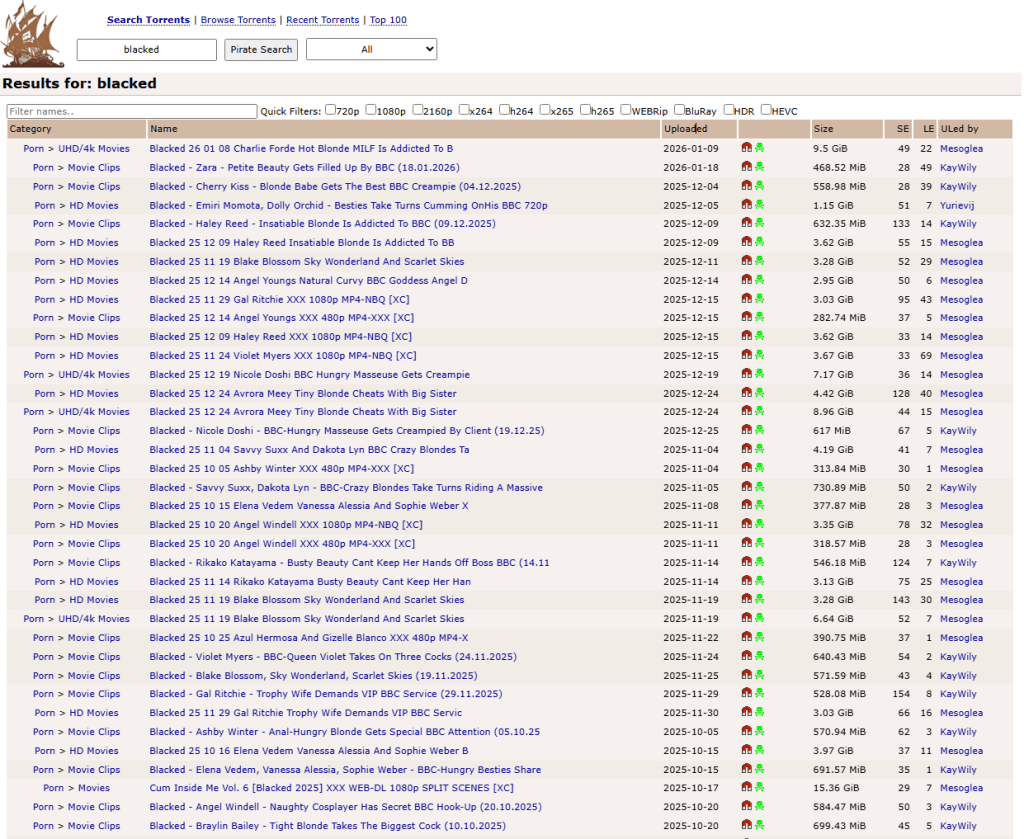
f you thought 2026 would be the year copyright piracy finally died, take a look at the screenshot above. It’s the middle of January, and the The Pirate Bay is humming along like it’s 2008.
Specifically, look at what’s topping the charts: Blacked content.
The brand owned by Strike 3 Holdings, LLC—the most aggressive copyright litigant in the United States—is being uploaded with clockwork precision. And if you look closely at the upload dates (Jan 09, Jan 18, 2026), you’ll see these files are hitting the swarm almost immediately after release.
But here is the billion-dollar question: Why is this still happening? And more importantly, does Strike 3 actually want it to stop?
The “Super-Uploaders”: Meet Mesoglea and KayWily
Look at the “ULed by” column in that image. You see two names dominating the feed: Mesoglea and KayWily.
These aren’t random users sharing a file they liked. These are dedicated uploaders. They follow a strict naming convention. They upload high-quality rips (1080p, 4K). They are consistent, reliable, and prolific.
In the world of BitTorrent defense, names like these raise eyebrows. Theories have circulated for years in defense attorney circles that some of these “reliable” uploaders might not be the heroes of the piracy community they appear to be. Are they super-fans? Are they automated bots scraping the web? Or is there something darker at play?
The Incentive Structure: Why Kill the Golden Goose?
Let’s put on our cynical hats for a moment and speculate on the incentives.
Strike 3 Holdings files hundreds of lawsuits a month (we just saw them drop 352 cases over the holidays). Their business model relies heavily on identifying IP addresses of people downloading their movies via BitTorrent.
Here is the Catch-22: To sue someone for copyright infringement, infringement must occur.
If Strike 3 were to successfully wipe every torrent site off the internet, or if they successfully used DMCA takedowns to scrub these “Mesoglea” uploads the second they appeared, what happens?
- The piracy stops. (Good for copyright, theoretically).
- The “John Doe” defendants disappear. (Bad for the settlement revenue stream).
Does Strike 3 Have an Incentive to Go After Users?
Yes. They have a massive financial incentive to go after the downloaders. Every IP address caught in the swarm is a potential settlement check, usually ranging from $750 to several thousand dollars.
But do they have an incentive to stop the uploaders?
If you believe the “Honeypot Theory”—a favorite among defense lawyers—the answer is no.
- The Leak is the Bait: High-quality, easy-to-find torrents act as a lure.
- The Trap: Users see a file sitting there with 154 seeders (like the “Gal Ritchie” file in the image). It looks safe. It looks healthy. They click download.
- The Snap: Strike 3’s monitoring software logs the IP. Three weeks later, a subpoena hits the ISP.
If Strike 3 actually “fixed” the leak problem, they would effectively be firing their entire legal department.
The Verdict
As long as users like Mesoglea and KayWily keep the content flowing, Strike 3 Holdings will keep the lawsuits coming. It is a symbiotic relationship—a circle of life where content gets uploaded, users take the bait, and the courts get flooded with paperwork.
So, when you see those shiny new uploads on The Pirate Bay with 2026 timestamps, just remember: You aren’t looking at free entertainment. You’re looking at a fishing lure.
 Strike 3 Litigation
Leave a comment