In the dark and twisted comedy that is the “copyright troll” business, we’ve focused a lot on the lawyers, the judges, and the unsuspecting “John Does.” But what about the silent partner in this whole enterprise? The one who holds the keys to the kingdom, or more accurately, the IP addresses?
We’re talking about the Internet Service Providers (ISPs).
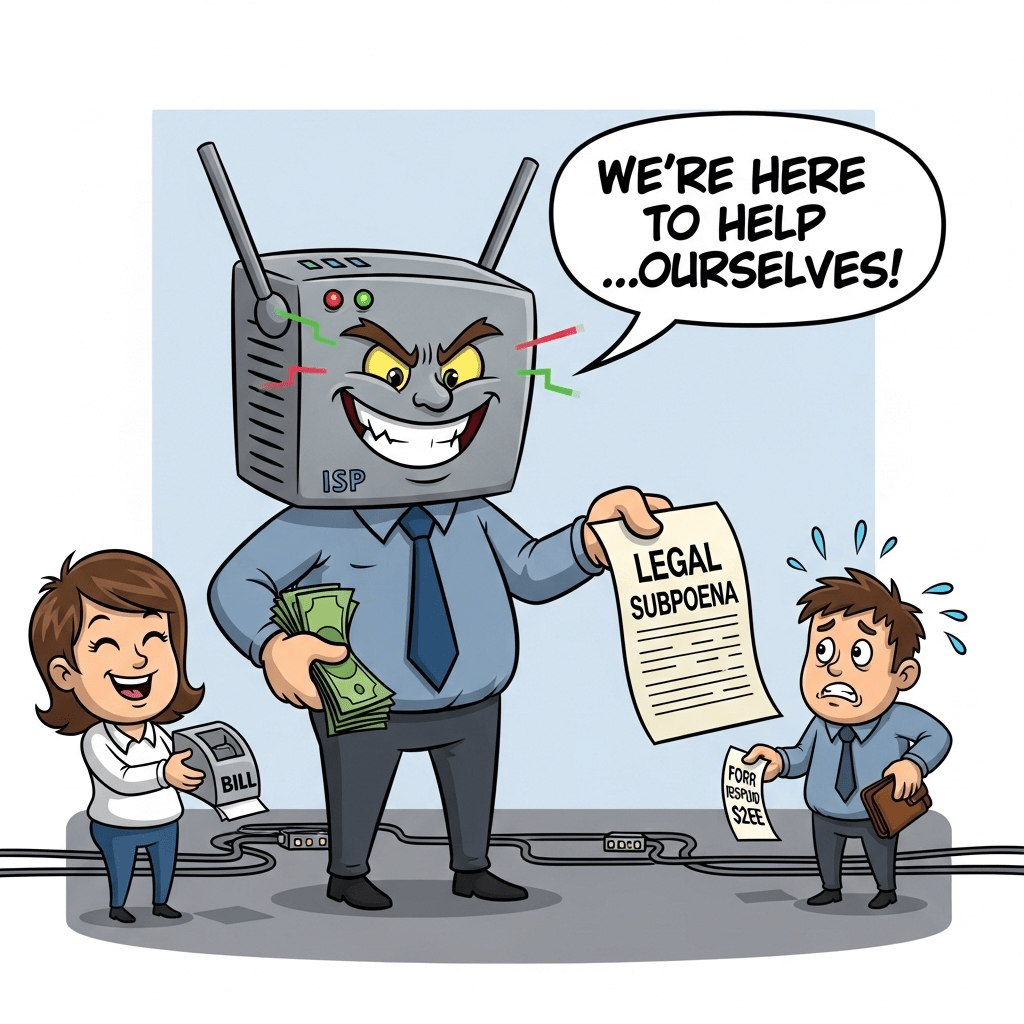
When Strike 3 Holdings files a lawsuit, their first step is a subpoena to the ISP. That little piece of paper demands the name and address of the subscriber tied to a specific IP address at a specific time. And in a move that feels less like a fight for your privacy and more like a shrug, the ISPs almost always comply. They are the gravediggers of your digital anonymity.
But why?
The Art of the Transaction: A Cost-Benefit Analysis
The answer, like most things in this plutocratic system, is likely tied to money. For a massive corporation like an ISP, legal battles are an everyday reality. But defending the privacy of every single subscriber against a “John Doe” lawsuit is a headache. A costly, resource-draining, unending headache.
Imagine the conversation in a boardroom. The options are:
- Fight every subpoena: This means dedicating a team of lawyers to litigate against Strike 3 Holdings and its seemingly endless supply of cases. The legal fees would be astronomical, the process would be a logistical nightmare, and the outcome isn’t even guaranteed. It’s a lose-lose situation.
- Comply and charge a small fee: The ISP receives a subpoena, processes the information, and hands over your data. In many cases, they even charge a small administrative fee for this service. It’s a quick, easy, and profitable transaction.
From a purely financial standpoint, the choice is obvious. Why spend a million dollars fighting a legal battle when you can make a few bucks by simply complying? Your privacy, in this equation, is less of a right and more of a liability.
The Unspoken Alliance
This isn’t to say that ISPs are evil masterminds. They are simply rational actors in an economic system that incentivizes compliance over resistance.
This tacit understanding between the copyright trolls and the ISPs forms the foundation of the entire “gravy train” business model. The system works because all the major players—the lawyers, the judges, and the ISPs—have found a way for it to be a net positive for them. The only one left out of the benefit equation is the individual staring at a settlement demand for a few hundred dollars.
It’s a dark, humorous, and deeply unsettling reality. The companies you pay to connect you to the internet are also the ones most likely to give up your information when a well-funded legal firm comes knocking. In the grand play of copyright trolling, the ISP isn’t a hero, a villain, or even an accomplice. It’s a compliant and profitable spectator.


Leave a Reply