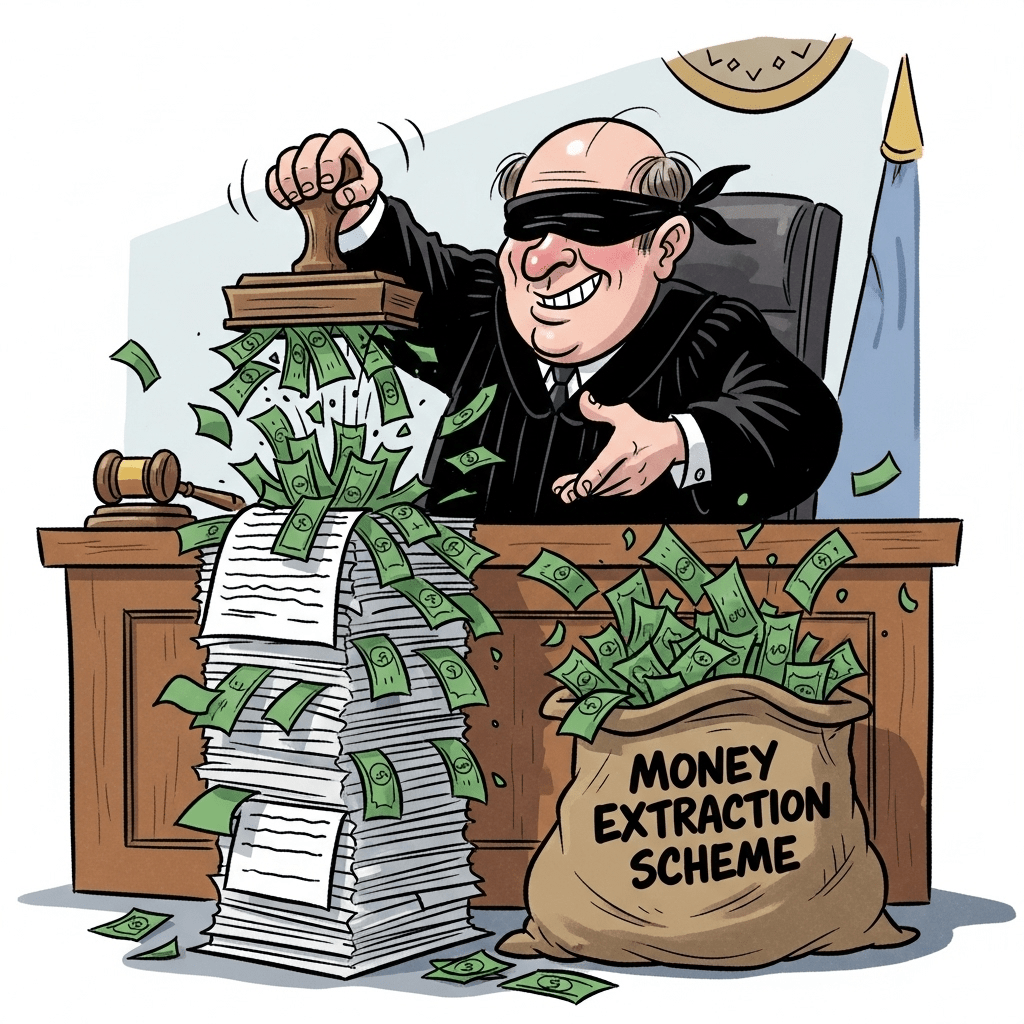
Remember that image of the overworked federal judge, buried under a mountain of “Strike 3 Holdings v. John Doe” paperwork? It’s funny, but it also raises a seriously dark question: are judges even looking at these requests anymore?
In the endless saga of copyright trolling, the judicial system seems to have become another compliant player in the wealth extraction game. Federal judges, once the guardians of due process, are now, in many cases, acting like little more than a rubber stamp for every subpoena that comes their way.
The Burden of Justice (or Lack Thereof)
One has to wonder: is it pure, unadulterated laziness? Is it easier to simply sign the papers and move on to the next case than to actually read the fine print and challenge the validity of a subpoena? Perhaps these judges feel that they have no legal choice, that the law is so stacked in favor of the copyright holder that resistance is futile. They may feel it’s just a formality, a required step on the way to an inevitable settlement.
But in an environment where these cases are so numerous, the act of “just signing” becomes a powerful endorsement of a dubious business model. The judge’s signature gives the ISP a clear signal: “It’s fine to hand over this person’s private information.” The system, with a quiet nod and a stroke of a pen, gives the green light to the very behavior we’ve been documenting.
Is It a Conspiracy or a Comical Incompetence?
Now, let’s go full conspiracy theory for a moment. Are these judges taking kickbacks or bribes to sign these subpoenas? The dark humor of the idea is almost too much. The mental image of a judge in a back alley, accepting a briefcase full of money from a shadowy “Strike 3” figure is something straight out of a satirical cartoon . While the likelihood of such a blatant conspiracy is low, it highlights the frustration and suspicion that this unchecked process generates.
The truth is likely much more mundane, but no less disheartening: a combination of institutional inertia and a lack of will to challenge the status quo. The judges, like the ISPs and the new lawyers on the “gravy train,” are simply playing their part in a system that’s more profitable when it’s a well-oiled machine of wealth extraction rather than a meticulous arbiter of justice.
In the end, it’s a self-perpetuating cycle. The plaintiffs file lawsuits, the ISPs comply, and the judges rubber-stamp the process. And with each new case, the joke gets a little less funny and the reality a little more unsettling. Your digital privacy, it seems, is a small price to pay for a smooth-running legal machine.
 Strike 3 Litigation
Leave a comment